Newsletter Subscribe
Enter your email address below and subscribe to our newsletter

 ByJohn A
Choosing the right air cooling system is essential for maintaining comfortable indoor conditions, managing heat from equipment, and supporting efficient operations in large industrial and commercial buildings. Factories, warehouses, production facilities, and public buildings often require more than standard room air conditioning because they have larger floor areas, higher ceilings, varying occupancy levels, and different ventilation requirements.
The most suitable cooling technology depends on several factors, including building size, heat generation, outdoor temperature, humidity, air circulation, and operating costs. Options range from conventional air conditioning to direct evaporative coolers, indirect evaporative cooling systems, and ducted cooling equipment.
Understanding these options helps facility managers and business owners make informed decisions based on their actual requirements rather than choosing equipment based on capacity or purchase price alone.
This guide explores the main air cooling solutions for large spaces, explains their advantages and limitations, and outlines the factors to evaluate before investing in an industrial or commercial cooling system.
Large buildings present cooling challenges that differ from those found in smaller enclosed spaces. Their internal temperatures can be affected by machinery, lighting, solar heat gain, occupancy, and the movement of outdoor air. A suitable system must address these factors while distributing cooled air effectively throughout the building.
Industrial machinery, electrical equipment, motors, and production processes can release considerable amounts of heat. If this heat is not managed properly, indoor temperatures may rise and affect working conditions, equipment reliability, and process requirements.
Cooling system design should account for both the building’s general heat gain and any concentrated sources of heat. The required capacity depends on equipment loads, operating schedules, ventilation, and the temperature conditions that the facility needs to maintain.
Indoor temperature and air movement influence thermal comfort. Large facilities may have different temperature conditions across production areas, storage sections, offices, and other occupied spaces.
An effective cooling strategy considers occupancy, air distribution, ceiling height, and the location of heat sources. Properly designed systems help reduce uneven cooling and support more consistent indoor conditions.
Cooling and ventilation are related but separate functions. While cooling equipment reduces air temperature, ventilation helps manage indoor pollutants, odours, and accumulated heat by supplying and exhausting air as required.
Facilities should evaluate filtration, outdoor air quality, exhaust requirements, and applicable building standards. Cooling equipment must be integrated with an appropriate ventilation strategy rather than treated as a complete indoor air quality solution.
Different cooling technologies suit different operating environments. Understanding how each system works, along with its limitations, helps narrow the options before detailed equipment sizing and installation planning.
Conventional air conditioning systems generally use a refrigeration cycle to remove heat from indoor air. They can provide controlled temperatures and, depending on the system, humidity management. These features make them suitable for buildings with specific indoor environmental requirements.
However, installation and operating costs depend on system capacity, energy efficiency, building insulation, and operating hours. Large facilities may also require multiple units or a centralised system to distribute cooling effectively.
Direct evaporative coolers pass air through a wetted cooling medium. As water evaporates, it absorbs heat and lowers the temperature of the outgoing air. This process can offer an energy-efficient cooling option when outdoor conditions are suitable.
These systems generally work best in hot, dry climates. Because evaporation adds moisture to the supply air, their suitability depends on acceptable indoor humidity levels and adequate ventilation.
Indirect evaporative cooling uses a heat exchanger to transfer heat between separate air streams. Water evaporation cools one stream, allowing the primary supply air to lose heat without direct contact with the evaporating water.
This arrangement limits direct moisture addition to the supply air. Its effectiveness still depends on outdoor conditions, heat exchanger performance, and system configuration. Facilities with demanding temperature or humidity requirements may need supplementary cooling.
Ducted cooling systems distribute conditioned or cooled air through a network of ducts and outlets. They can serve multiple areas and help provide more organised air distribution across large buildings.
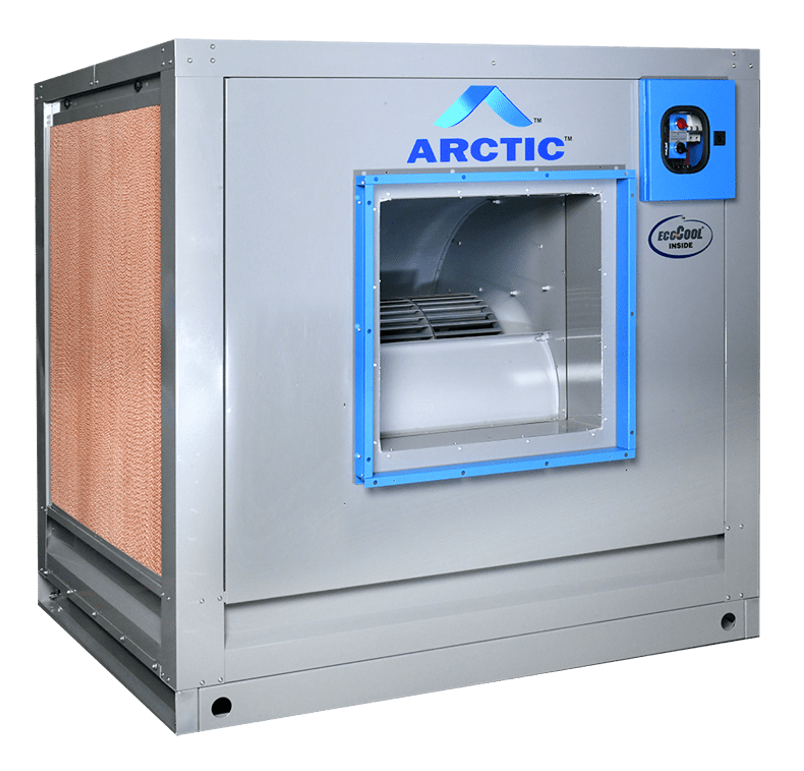
Correct duct sizing, fan capacity, static pressure, outlet placement, and return or exhaust arrangements are important for effective performance. For industrial facilities, ducted evaporative coolers may be worth considering when evaporative cooling aligns with the climate and ventilation requirements.
Spot cooling directs cooled air toward specific work areas or heat sources instead of treating the entire building uniformly. This approach can be useful when heat is concentrated in particular zones or when full-building cooling is unnecessary.
The suitability of spot cooling depends on the area being served, required airflow, heat intensity, and worker comfort requirements. It may complement a wider ventilation or cooling strategy.
Selecting an appropriate system involves evaluating the building, operating conditions, and expected performance. A structured assessment helps avoid undersized equipment, unnecessary energy use, and unsuitable cooling technology.
Measure the floor area, ceiling height, and volume of the space. Consider how many people occupy the building, how frequently doors open, and whether different zones have different cooling requirements.
Large spaces may need carefully planned air distribution to prevent cooled air from remaining near outlets while distant areas receive insufficient airflow.
Cooling load calculations should account for machinery, lighting, occupants, solar gain, building materials, and outdoor air entering the facility. These factors determine the amount of heat that the system must remove.
Required airflow, measured in units such as cubic metres per hour, must also be assessed. A qualified HVAC professional can use these calculations to establish appropriate equipment capacity and distribution requirements.
Climate strongly affects cooling performance, particularly for evaporative systems. Hot, dry air generally supports more effective evaporation than hot, humid air.
Review seasonal temperature and humidity conditions rather than relying only on average annual weather. The system should be selected for the conditions under which the facility actually operates.
Determine how much outdoor air the building needs and how heated air will leave the space. Evaporative cooling systems often depend on sufficient air exchange to maintain effective operation.
Ventilation design should also consider pressure balance, filtration, building use, and applicable safety requirements.
Consider whether the facility needs precise temperature control, humidity management, substantial fresh-air delivery, or cooling across several zones. Equipment should meet these priorities while remaining compatible with the building’s infrastructure.
The lowest purchase price does not necessarily represent the lowest long-term cost. Compare equipment based on installation, energy use, water requirements, maintenance, expected service life, and the cooling performance needed.
Upfront expenses include the cooling unit, ductwork, electrical connections, controls, installation labour, and any building modifications. Centralised and ducted systems may require more installation planning than simpler arrangements.
Refrigeration-based air conditioning typically uses electricity to operate compressors and fans. Evaporative cooling relies on fans and water circulation, and its electricity requirements can be lower under suitable conditions. Water consumption must also be considered.
Actual performance varies with climate, equipment efficiency, operating hours, and system sizing. Compare manufacturer data under relevant operating conditions.
All cooling systems require maintenance. Filters, fans, electrical components, drainage, and controls need inspection, while evaporative equipment also requires attention to water distribution and cooling media.
Calculate expected electricity and water expenses alongside maintenance, component replacement, and installation costs. A total cost of ownership assessment offers a more useful comparison than purchase price alone.
For additional information about available equipment, visit ARCTIC and review the cooling solutions suited to your application.
The most suitable cooling system depends on the facility’s processes, ventilation needs, indoor conditions, and local climate. Each application should be assessed individually before selecting equipment.
Manufacturing plants often need to manage heat from production machinery while maintaining adequate airflow for employees. Industrial cooling systems should be selected according to heat loads, production schedules, and temperature requirements.
Warehouses require cooling strategies that account for large air volumes, roof heat gain, storage layouts, and frequent loading activities. Ducted systems and evaporative cooling may be appropriate where climate and ventilation conditions support their use.
Food-related facilities may have specific temperature, humidity, hygiene, and air filtration requirements. Cooling equipment must meet applicable food safety standards and process specifications. Evaporative cooling should only be considered where its moisture characteristics are compatible with the application.
Commercial kitchens generate substantial heat from cooking equipment and require effective exhaust ventilation. Cooling solutions should work alongside extraction systems to support suitable indoor conditions without disrupting ventilation balance.
Occupied buildings require attention to thermal comfort, fresh-air supply, filtration, and noise levels. Conventional air conditioning, centralised HVAC, or suitable evaporative systems may be considered depending on climate, occupancy, and indoor environmental requirements.
Before installation, review the building infrastructure and confirm that the selected system can meet its cooling and ventilation requirements. Planning these details early can reduce installation difficulties and support reliable operation.
Review the position of equipment, duct routes, air outlets, and exhaust points. Air should reach the intended areas without creating significant temperature differences or obstructing normal operations.
Confirm that the electrical infrastructure can support the cooling equipment. Evaporative systems also need a suitable water supply, drainage arrangements, and appropriate water management procedures.
Verify the required cooling capacity, airflow, and operating conditions with a qualified HVAC professional. The design should account for heat loads, outdoor conditions, and ventilation requirements.
Ensure that technicians can access filters, fans, cooling media, controls, and other components. Follow manufacturer recommendations for inspection, cleaning, and scheduled maintenance.
The right option depends on heat generation, building size, climate, ventilation needs, and temperature requirements. Conventional air conditioning, direct evaporative cooling, indirect cooling, or ducted systems may be suitable after a professional assessment.
Evaporative coolers can use less electricity under suitable conditions because they do not rely on the same refrigeration process as conventional air conditioners. However, performance depends on humidity, system design, water consumption, and the cooling target.
Yes, a properly designed centralised or ducted system can serve a large warehouse. Its suitability depends on airflow requirements, building layout, heat loads, and the need for separate temperature zones.
Yes. Regular maintenance helps preserve airflow, cooling performance, and operational reliability. Inspection schedules should follow the equipment manufacturer’s guidance and account for operating conditions.
Start by assessing floor area, ceiling height, heat sources, occupancy, outdoor conditions, and ventilation requirements. A qualified HVAC professional can perform a cooling load calculation to determine suitable equipment capacity.
Choosing the best air cooling solution for a large industrial or commercial space requires more than comparing equipment prices. Building dimensions, internal heat loads, outdoor humidity, airflow requirements, energy consumption, and maintenance needs all influence system performance.
Conventional air conditioning may suit facilities requiring precise environmental control, while direct and indirect evaporative cooling can offer alternatives under appropriate conditions. Ducted systems can help distribute cooled air across larger spaces when designed to match the building’s requirements.
Review the available options, assess long-term operating costs, and confirm the technical specifications before making a decision. Explore the cooling equipment available from ARCTIC and Contact Us to discuss your facility’s requirements and identify a suitable cooling approach.