Newsletter Subscribe
Enter your email address below and subscribe to our newsletter

 ByJohn A
Lithium-ion batteries are essential components in electric vehicles, renewable energy storage systems, consumer electronics, and industrial power applications. As demand for reliable energy storage continues to grow, manufacturers must maintain strict quality and safety standards throughout the production process. One important factor influencing battery quality is the control of moisture in the manufacturing environment.
Lithium and several battery materials are highly sensitive to moisture. Even small amounts of water vapor can interfere with material properties, affect electrochemical performance, and increase production risks. Conventional air conditioning alone may not achieve the extremely low humidity levels required for sensitive battery manufacturing processes. Specialized dry rooms supported by advanced dehumidification technology are therefore essential.
Well-designed Battery Dry Rooms provide a controlled environment in which humidity, temperature, airflow, and air cleanliness can be managed according to production requirements. These systems help manufacturers maintain consistent processing conditions, protect moisture-sensitive materials, and support reliable battery production.
Lithium-ion battery production involves several materials that can absorb or react with moisture. These materials must be handled under carefully controlled environmental conditions to protect their chemical characteristics and suitability for manufacturing.
When moisture enters sensitive processing areas, it may contribute to unwanted chemical reactions, material degradation, and inconsistencies in battery performance. In some circumstances, moisture contamination can also increase safety concerns. Effective humidity management is therefore a fundamental part of manufacturing quality control rather than an optional environmental improvement.
Battery performance depends on the quality of its materials, the precision of its assembly, and the consistency of its manufacturing conditions. Excess moisture can compromise these factors and contribute to reduced charging capacity, shortened service life, or inconsistent product quality.
Maintaining a suitable low-humidity environment helps reduce avoidable moisture exposure during production. It also supports process repeatability, allowing manufacturers to establish more consistent conditions across production batches.
Moisture control is particularly important when handling reactive battery materials. Lithium can react with water, producing heat and hydrogen gas. Depending on the material, process conditions, and extent of exposure, such reactions can create serious hazards.
A properly engineered dry room helps limit exposure to moisture, but it must form part of a broader safety strategy. Appropriate ventilation, material handling procedures, fire protection, process controls, and risk assessments remain essential to safe battery manufacturing.
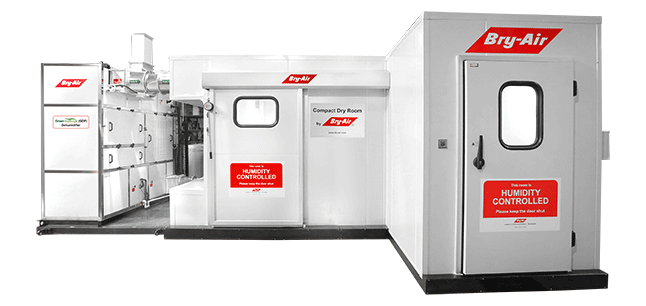
A battery dry room is an enclosed production environment designed to maintain very low moisture levels. Its dehumidification system removes water vapor from the air and supplies conditioned air to designated manufacturing areas.
Desiccant dehumidification is widely used for applications that require humidity levels below the practical operating range of conventional cooling-based systems. Desiccant materials attract and retain water vapor, allowing the equipment to reduce air moisture to the required level. The moisture collected by the desiccant is subsequently removed through a regeneration process so that the system can continue operating.
Bry-Air’s Green DryPurge® technology is designed for applications requiring ultra-low dew points. According to the company’s product information, its dry room solutions can be engineered for demanding moisture-control requirements, with configurations depending on the application and operating conditions.
Relative humidity indicates how much water vapor is present in the air relative to the maximum amount it can hold at a given temperature. Dew point provides another useful measure of moisture content and is especially important in very dry environments.
Lithium-ion battery production may require dew points significantly below those used in ordinary industrial facilities. The precise target depends on the battery chemistry, materials, manufacturing stage, and process specifications.
An appropriately designed system maintains the required dew point by accounting for moisture entering through fresh air, personnel movement, doors, materials, equipment, and other sources. The dehumidification capacity must be sufficient to manage these loads while preserving stable environmental conditions.
The room enclosure plays a major role in controlling moisture. Vapour-tight walls, properly sealed joints, insulated panels, and carefully designed entry points help prevent humid outside air from entering the controlled environment.
Insulation also reduces unwanted heat transfer, supporting more stable operating conditions and helping the environmental control system perform efficiently. The enclosure should be designed around the facility layout, production equipment, structural requirements, and applicable safety standards.
Every door opening can introduce moisture into a low-dew-point environment. Airlocks and anterooms help limit this exchange by creating a transition zone between the production area and the surrounding facility.
Personnel entry procedures, suitable door arrangements, and controlled material transfers can further reduce unnecessary moisture ingress. These measures are especially important in facilities with frequent movement of workers, raw materials, and finished components.
Continuous monitoring helps operators verify that the room remains within specified environmental limits. Dew-point sensors, humidity instruments, temperature sensors, and control systems can provide information needed to manage equipment operation and identify deviations.
Automated controls may adjust dehumidification, airflow, and other system functions according to operating conditions. Alarm systems can alert personnel when readings move outside defined limits, supporting faster investigation and corrective action.
Stable environmental conditions help manufacturers reduce variation caused by changing moisture levels. When production areas maintain their specified humidity and dew point, sensitive materials can be handled under more predictable conditions.
This consistency supports quality assurance, process validation, and production planning. However, environmental control must be integrated with appropriate raw material inspection, equipment maintenance, operator training, and in-process quality checks.
Moisture contamination may contribute to material rejection, production interruptions, and additional inspection requirements. A properly sized dry room can reduce exposure risks by controlling the environment around critical manufacturing stages.
The extent of any improvement depends on the existing facility, process design, operating discipline, and quality management system. Manufacturers should assess performance using relevant indicators, including environmental stability, rejected materials, downtime, and production yield.
Battery production includes electrode preparation, electrode handling, cell assembly, electrolyte filling, sealing, testing, and other specialized operations. Each stage may have different environmental requirements.
A dry room design should identify which processes need the strictest moisture control and how air should be distributed to those areas. This approach helps align system capacity with actual process demands rather than applying a uniform specification to every room.
The required dehumidification capacity depends on more than room dimensions. Engineers must assess moisture introduced by outside air, people, materials, equipment, leakage, and operational activities. They should also consider local climate conditions and expected changes in production volume.
Accurate moisture-load calculations help determine the appropriate equipment capacity and reduce the risk of underperforming or unnecessarily oversized systems.
Dry rooms may require continuous operation and substantial dehumidification capacity. Energy use should therefore be evaluated alongside the required dew point, airflow, regeneration method, cooling requirements, and expected operating schedule.
Manufacturers should also assess maintenance access, sensor calibration, filter replacement, spare parts, and the availability of technical support. A system that is difficult to maintain can become less reliable over time, even if its initial specifications appear suitable.
A solution should be developed around the battery chemistry, production process, facility configuration, safety requirements, and future expansion plans. Equipment selection, air distribution, room sealing, monitoring, and control strategies need to work together as one coordinated system.
Bry-Air provides engineered dry room solutions incorporating its Green DryPurge® technology for demanding low-dew-point applications. When evaluating Lithium Battery Dry Rooms, manufacturers should review the required environmental conditions, equipment performance, integration requirements, and ongoing operational support before finalizing a design.
Battery dry rooms play an important role in maintaining the controlled environmental conditions required for lithium-ion battery manufacturing. Effective moisture management helps protect sensitive materials, support consistent production quality, reduce contamination risks, and maintain suitable conditions across critical manufacturing stages.
Achieving these outcomes requires more than installing a dehumidifier. Airtight construction, insulation, airlocks, suitable airflow, continuous monitoring, and accurate moisture-load calculations must be considered as part of an integrated system. The required dew point and humidity limits should always be established according to the specific battery chemistry and manufacturing process.
Manufacturers planning a new facility or upgrading an existing production environment should evaluate their technical requirements carefully and work with experienced specialists to develop an appropriate solution. To discuss dry room requirements, environmental control systems, and application-specific options, visit Bry-Air’s Contact Us page.