Newsletter Subscribe
Enter your email address below and subscribe to our newsletter

 ByJohn A
Heating and cooling outdoor air can account for a significant part of a building’s HVAC energy demand. Ventilation requires conditioned indoor air to be exhausted while outdoor air enters the building, creating an opportunity to recover energy before the two air streams leave the system. An air to air heat exchanger transfers energy between these separate air streams without directly mixing them. This allows incoming ventilation air to be preconditioned before it reaches the main HVAC equipment, helping reduce the amount of heating or cooling required.
Ventilation is necessary for maintaining indoor air quality, but outdoor air rarely arrives at the same temperature and humidity conditions required inside a building. During cooling periods, hot outdoor air can increase the load placed on cooling equipment. During heating periods, cold outdoor air requires additional energy to reach the required supply temperature.
Exhaust air leaving a conditioned space already contains useful thermal energy. Instead of allowing that energy to leave the building unused, an air-to-air recovery device can transfer part of it to the incoming outdoor air. The effectiveness of this process depends on the exchanger design, airflow rates, temperature difference, humidity conditions, and operating strategy.
Energy recovery can provide several HVAC benefits:
The recovery process does not eliminate the need for heating or cooling equipment. Instead, it reduces the amount of work that downstream HVAC components need to perform.
An air-to-air heat exchanger is a device designed to transfer thermal energy between two separate air streams. One stream normally consists of conditioned exhaust or return air, while the other contains incoming outdoor air. The exchanger transfers energy through a heat-transfer surface or medium while maintaining separation between the two air paths.
The term “heat exchanger” often refers primarily to sensible heat transfer, meaning the transfer of energy associated with temperature. Some air-to-air energy recovery technologies can also transfer moisture, allowing latent energy to move between the air streams.
The basic operating arrangement includes:
The direction of energy transfer changes according to the relative temperature and moisture conditions of the two air streams.
The operating principle is based on the natural movement of energy from a higher-energy air stream toward a lower-energy air stream. The two air streams travel through separate passages within the recovery equipment. Heat passes through the exchanger medium while the air streams remain separated according to the system design.
During cooling operation, cooler exhaust air can remove part of the sensible heat from incoming outdoor air. During heating operation, warmer exhaust air can transfer useful heat to cold outdoor air. This preconditioning reduces the temperature difference that the primary HVAC equipment must overcome.
The exhaust stream contains energy that was previously added to the indoor air by heating, cooling, or other building systems. As that air passes through the recovery device, part of its energy can be transferred to the incoming outdoor-air stream.
The amount recovered depends on the temperature difference, airflow relationship, exchanger effectiveness, surface characteristics, and operating conditions. Proper sizing is therefore essential because an exchanger that is poorly matched to the required airflow may not deliver the expected recovery performance.
Sensible energy transfer relates to changes in air temperature without considering moisture transfer. A sensible heat exchanger can lower the temperature of incoming outdoor air during cooling operation or raise its temperature during heating operation.
This reduces the sensible load presented to the cooling or heating coil. The result can be a lower coil load and potentially lower energy consumption across the HVAC system.
Latent energy is associated with moisture contained in the air. Some energy recovery technologies can transfer both sensible and latent energy, depending on the properties of the recovery medium.
Latent recovery can be particularly relevant in systems where outdoor humidity contributes significantly to the cooling and dehumidification load. By transferring moisture-related energy between the air streams, an energy recovery system can help reduce the amount of work required from downstream humidity-control equipment.
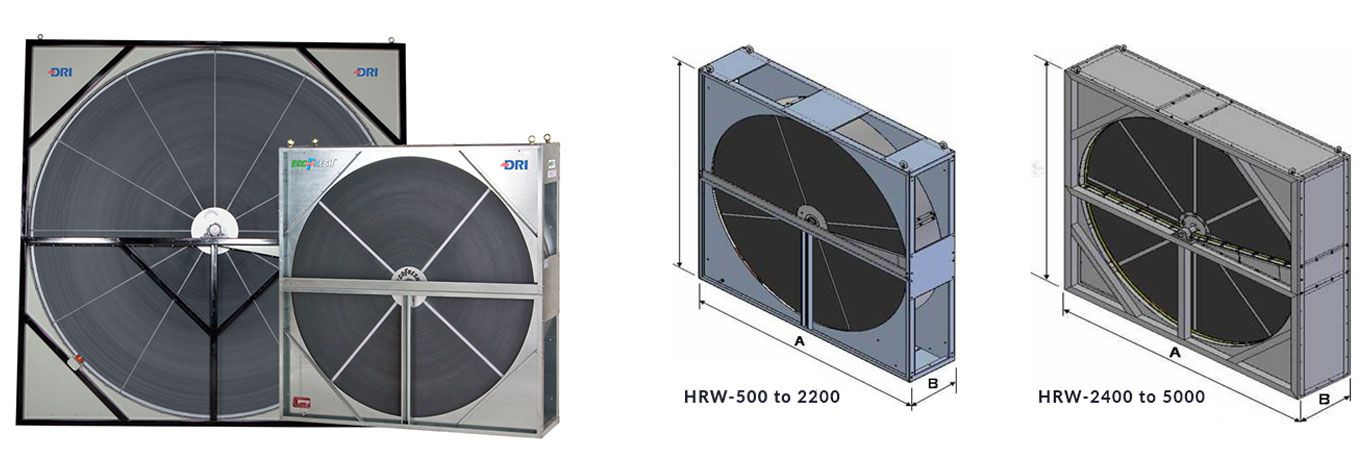
An energy recovery wheel, also called a rotary heat exchanger or rotary energy recovery wheel, is a rotating device that transfers energy between exhaust and incoming air streams. The wheel contains a heat-transfer matrix that rotates between the two air paths.
As one section of the wheel passes through the exhaust air, it absorbs energy. The rotating wheel then carries that energy into the outdoor-air stream, where the energy is released into the incoming air. Depending on the wheel material and design, the process can transfer sensible energy alone or both sensible and latent energy.
An energy recovery wheel can therefore support ventilation systems where outdoor-air conditioning represents a significant portion of the total HVAC load. Its performance depends on factors such as wheel construction, rotational speed, airflow arrangement, face velocity, temperature difference, and moisture conditions.
An air-to-air heat exchanger differs from a conventional refrigerant or hydronic HVAC heat exchanger in its energy source and operating arrangement. Conventional coils typically transfer energy between air and a fluid such as chilled water, hot water, or refrigerant. Air-to-air recovery equipment instead transfers energy between two air streams.
This distinction affects how the equipment is integrated into a ventilation system. An air-to-air exchanger is generally positioned so that exhaust air can transfer energy to incoming outdoor air before the outdoor air reaches the primary heating or cooling equipment.
The main differences include:
Not every HVAC application uses a rotating recovery wheel. Fixed-core technologies provide another method for transferring energy between separate air streams. These systems use stationary heat-transfer surfaces through which energy moves from one air path to another.
Core energy recovery solutions can be designed for applications where a fixed heat-transfer structure is preferred. Membrane-based cores may also support sensible and latent energy transfer depending on their construction and application requirements.
Core systems can be evaluated based on airflow arrangement, required recovery efficiency, pressure drop, installation space, contamination concerns, and maintenance requirements. Selecting between a rotary wheel and a fixed-core exchanger requires consideration of the complete ventilation system rather than recovery efficiency alone.
The rated performance of an air-to-air heat exchanger does not exist independently of the HVAC system. Actual recovery depends on operating conditions and system configuration. Engineers need to consider both the exchanger itself and the air-handling system surrounding it.
Important factors include:
Pressure drop deserves particular attention because a recovery device can reduce thermal loads while increasing fan energy if the airflow resistance is excessive. System selection should therefore consider recovered energy and additional electrical demand together.
Energy recovery reduces the amount of conditioning required for outdoor air. Instead of sending outdoor air directly to a cooling or heating coil at its full outdoor condition, the recovery device first moves the air closer to the desired supply condition.
This can reduce coil load and improve the operating conditions of the primary HVAC equipment. Depending on system design, the recovered energy may also reduce peak heating or cooling demand, which can influence equipment sizing and overall plant operation.
The actual benefit depends on ventilation rates, climate, occupancy, operating schedules, and equipment performance. A properly designed recovery system should therefore be evaluated using the expected annual operating conditions rather than relying only on a single rated efficiency value.
Yes. Air-to-air heat recovery can be integrated with many ventilation and cooling arrangements. The recovery device can precondition outdoor air before it enters an air-handling unit, dedicated outdoor-air system, or other ventilation equipment.
In cooling applications, exhaust air may reduce the temperature of incoming outdoor air before the cooling coil. In heating applications, the same recovery principle can transfer useful heat from exhaust air to cold outdoor air.
Air-to-air recovery can also be combined with evaporative cooling technologies. For systems using cooling pads for air cooler, heat recovery and evaporative processes can serve different functions within the overall air-treatment sequence. The exchanger manages energy transfer between air streams, while evaporative equipment uses water evaporation to reduce air temperature.
Air-to-air energy recovery can be considered wherever ventilation requires continuous outdoor-air intake and exhaust-air removal. Commercial and industrial buildings may have substantial ventilation loads that make recovery technically and economically relevant.
Common application categories include:
The appropriate recovery technology depends on the required airflow, contamination control requirements, climate, available installation space, and desired level of sensible or latent energy recovery.
Heat recovery equipment requires proper maintenance to maintain airflow and energy-transfer performance. Filters should be maintained according to the system’s operating requirements because blocked filters increase pressure drop and can reduce airflow through the recovery equipment.
Rotary wheels also require inspection of the wheel matrix, seals, drive system, and rotating components. Fixed-core systems should be checked for fouling, airflow restrictions, and damage to heat-transfer surfaces.
Maintenance planning should include:
Maintaining the complete ventilation system is as important as maintaining the exchanger itself. Poor airflow balance or neglected filtration can reduce the performance expected from an otherwise correctly selected recovery system.
Air-to-air heat exchangers provide a practical method for recovering energy that would otherwise leave a building through exhaust air. By transferring sensible or sensible and latent energy to incoming outdoor air, these systems can reduce the conditioning load placed on heating and cooling equipment. Rotary energy recovery wheels and fixed-core technologies offer different approaches to achieving this transfer, with selection depending on system requirements and operating conditions.
Effective energy recovery depends on more than the exchanger’s rated efficiency. Airflow balance, pressure drop, maintenance, humidity conditions, ventilation requirements, and integration with other HVAC equipment all affect actual performance. For projects evaluating air-to-air energy recovery, contact Desiccant Rotors International to discuss the requirements of the intended ventilation or air-treatment application.
An air-to-air heat exchanger transfers thermal energy between incoming outdoor air and outgoing exhaust air while keeping the two air streams separated. It can reduce the amount of heating or cooling required to condition ventilation air.
A conventional air-to-air heat exchanger can transfer sensible heat between air streams, while an energy recovery wheel is a rotating recovery device that can transfer sensible energy and, depending on its construction, latent energy as well.
Some energy recovery systems can transfer moisture as well as sensible heat. The ability to recover latent energy depends on the exchanger medium, membrane or wheel construction, air conditions, and system design.
It can reduce the heating and cooling load associated with outdoor air by preconditioning incoming ventilation air. The actual energy savings depend on climate, airflow, operating hours, recovery efficiency, pressure drop, and the rest of the HVAC system.
Selection should consider airflow, temperature and humidity conditions, sensible and latent recovery requirements, pressure drop, contamination concerns, installation space, maintenance needs, and compatibility with the existing HVAC system.