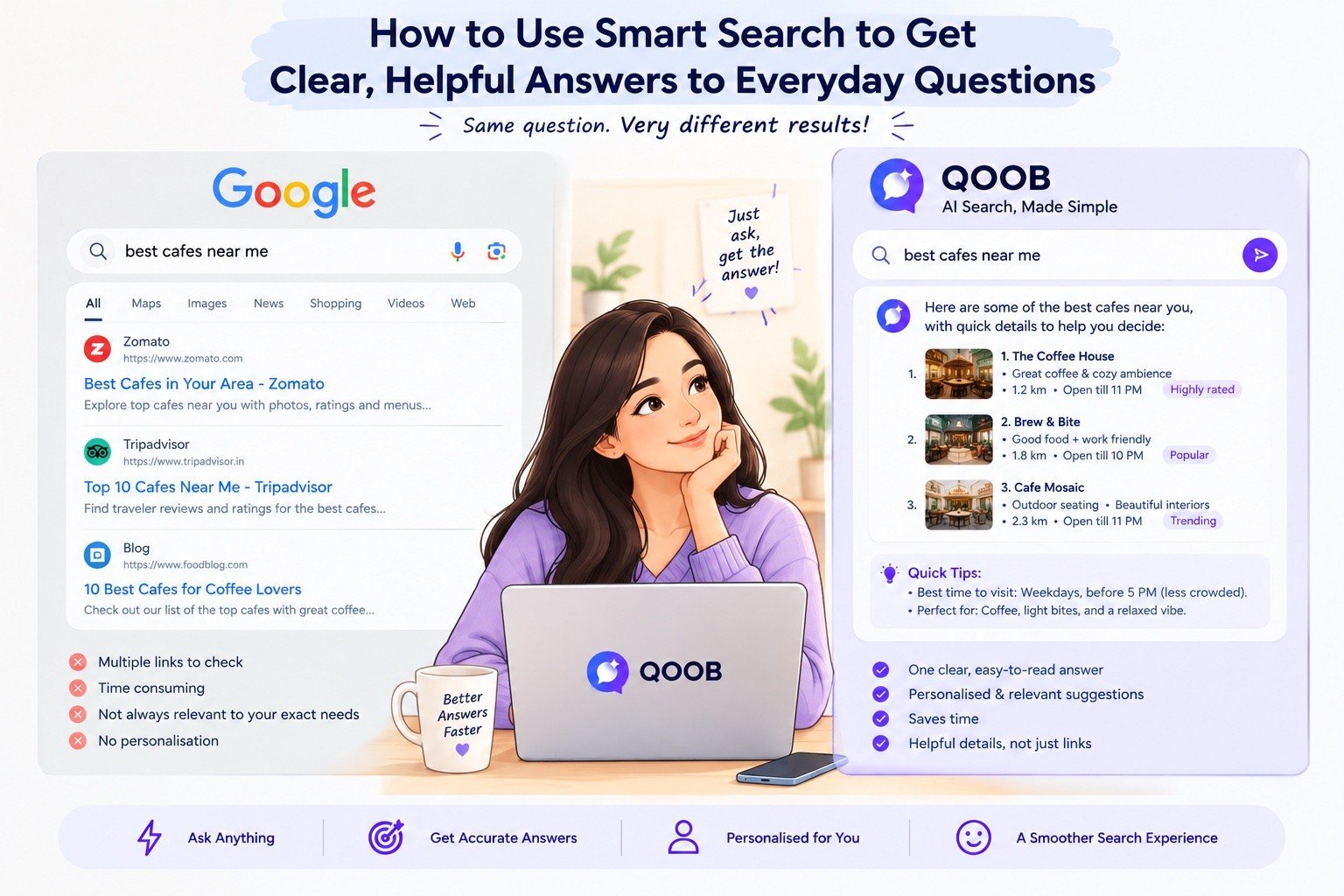

Finding reliable information online should be simple, but traditional search often requires opening multiple websites, comparing different opinions, and spending time looking for the right answer. Whether you want to understand a new concept, compare products, plan your day, or solve a common problem, searching for information can quickly become time-consuming.
This is where smart search can make a difference. By helping users find relevant information through natural-language questions and AI-powered assistance, smart search can make everyday online research more convenient.
Qoob offers Smart Search to help users explore information through a more convenient, question-focused search experience.
What Is Smart Search?
Smart search is an approach to finding information that goes beyond matching individual keywords. Depending on the platform, it can use artificial intelligence, natural-language processing, and contextual understanding to interpret what a person wants to know.
Instead of searching with disconnected words, users can ask complete questions in everyday language. The search experience can then help identify relevant information and present it in a more understandable format.
For example, rather than searching for “healthy breakfast quick recipes,” you could ask, “What are some healthy breakfast ideas I can prepare in less than 15 minutes?”
The second question explains your specific requirements, making it easier to find information that matches your needs.
How Is Smart Search Different From Traditional Search?
Traditional search engines generally return a list of webpages based on relevance to your query and other ranking signals. You often need to visit those pages and combine the information yourself.
Smart search tools may offer a more conversational experience by interpreting questions and helping organize information into useful answers. Their capabilities vary, so it is important to understand what each platform actually provides.
The main benefit is convenience. You can explain what you need in natural language instead of repeatedly adjusting short keyword searches.
How to Use Smart Search to Get Better Answers
Getting useful results starts with asking the right questions. Although smart search can simplify information discovery, the quality and relevance of the results still depend partly on how clearly you communicate your needs.
1. Ask a Clear and Specific Question
A broad question can produce a broad answer. Adding relevant details helps narrow the focus and makes the information more useful.
For example, instead of asking, “How can I save money?” try asking, “How can a working professional reduce monthly expenses while maintaining a reasonable lifestyle?”
The second question establishes a clearer context and helps focus the response on practical suggestions.
You do not need to write a complicated prompt. Simply explain what you want to know, why you need the information, and any important limitations.
2. Include Relevant Context
Context helps a search tool understand your requirements more accurately. When asking a question, consider including details such as your budget, location, experience level, available time, or intended outcome.
For example, someone searching for a laptop could ask, “Which features should a college student look for in a laptop under ₹50,000 for programming and online classes?”
This provides more useful direction than asking for the best laptop without explaining the purpose.
However, avoid sharing sensitive personal information, passwords, financial account details, or other private data when it is not necessary.
3. Break Complex Questions Into Smaller Parts
Some questions involve several decisions. Trying to address everything in a single query may result in an answer that lacks detail.
Suppose you want to plan a family holiday. You could begin by asking about suitable destinations, then explore estimated expenses, transportation options, accommodation, and activities.
Breaking the task into smaller questions makes the information easier to understand and verify.
4. Use Follow-Up Questions to Improve the Results
One useful feature of conversational search is the ability to refine an answer. If the first response is too general, ask for more detail or explain what is missing.
For example, after receiving suggestions for improving productivity, you could ask, “Which of these methods is easiest to follow for someone working from home?”
Follow-up questions help narrow the discussion and explore practical details that may not have been covered initially.
Everyday Situations Where Smart Search Can Help
Smart search can be useful for a wide range of everyday information needs. Its value comes from helping users find relevant information more efficiently, rather than requiring them to navigate multiple unrelated searches.
Learning and Understanding New Topics
Students, professionals, and curious readers often need straightforward explanations of unfamiliar subjects. Smart search can help explain concepts in simpler language, summarize key ideas, and suggest questions for further learning.
For example, you might ask, “Explain how inflation affects household expenses using a simple example.”
You can then request a more detailed explanation if you want to understand the economic principles behind the example.
For academic or professional work, verify important facts against reliable primary sources rather than treating an AI-generated response as automatically correct.
Comparing Products Before Buying
Online shopping often involves comparing specifications, prices, features, and customer requirements. Smart search can help organize the factors you should consider before making a purchase.
For example, you could ask, “What should I compare when choosing wireless headphones for online meetings and daily commuting?”
The answer might help you evaluate battery life, microphone quality, comfort, connectivity, and noise cancellation.
Always verify current prices, product specifications, warranty terms, and availability with the seller or manufacturer before purchasing.
Planning Daily Activities and Travel
Everyday planning often requires gathering information from different sources. Smart search may help you create checklists, compare options, and identify factors that deserve attention.
For travel, you could ask, “What should I consider when planning a three-day trip with children on a moderate budget?”
This can help you identify transportation, accommodation, meal planning, and activity requirements.
For time-sensitive information, such as opening hours, transport schedules, weather, or booking availability, confirm the latest details with the relevant official source.
Solving Common Everyday Problems
Smart search can also help you explore practical solutions to routine challenges. These might include organizing a workspace, learning basic cooking techniques, maintaining household items, or improving time management.
A specific question such as “How can I organize a small home office with limited storage space?” provides a clearer starting point than a general search for organization tips.
For potentially dangerous repairs, electrical work, medical concerns, or other high-risk situations, consult an appropriately qualified professional.
How to Evaluate the Quality of Smart Search Answers
A clear answer is not necessarily a correct answer. Before relying on information, consider its accuracy, relevance, completeness, and source quality.
Check the Facts and Sources
For important questions, look for supporting evidence from trustworthy sources. Official government websites, established research institutions, recognized professional organizations, and original documentation are often useful starting points.
If an answer includes statistics, legal requirements, health recommendations, or financial guidance, confirm the details with authoritative sources.
Look for Relevance, Not Just Length
Long answers can contain unnecessary details, while short answers can omit important qualifications. A helpful response should directly address your question and provide enough explanation to support your next step.
If the answer feels too broad, ask for a concise summary, a practical example, or a comparison based on your specific requirements.
Recognize the Limitations of AI
AI-powered search tools can misunderstand questions, provide outdated information, or generate incorrect statements. They may also overlook important exceptions.
Treat generated answers as a starting point for research rather than unquestionable facts. For significant decisions, cross-check critical claims and consult qualified professionals when appropriate.
Common Mistakes to Avoid When Using Smart Search
Even a useful search tool can produce disappointing results if the query is unclear or the information is used without verification.
Avoid Vague Queries
Questions such as “Tell me everything about technology” are too broad to produce consistently focused answers. Narrow the topic by specifying the information you need and the purpose of your search.
Do Not Accept Every Answer Without Checking
Convenient answers should not replace independent judgment. Verify important information, particularly when it concerns health, safety, legal obligations, financial decisions, or current events.
Avoid Overcomplicating Your Questions
You do not need technical terminology or lengthy instructions for every search. Begin with a clear question and add context only when it improves the results.
Protect Your Privacy
Before using any smart search platform, review its privacy policy and understand how it handles searches, personal information, and saved activity. Avoid entering confidential information unless you understand the relevant protections and have a legitimate reason to do so.
How to Get Started With Qoob Smart Search
If you want to explore a more conversational way of finding information, you can try Qoob Smart Search.
Start with an everyday question, such as how to compare two products, understand an unfamiliar concept, or organize a task. Make your question specific enough to communicate what you need, then review the response and ask follow-up questions if necessary.
As you become familiar with the experience, focus on using search to clarify your requirements, explore possible solutions, and identify information that deserves further verification.
The goal is not simply to find an answer quickly. It is to find information that is relevant, understandable, and useful for the decision you need to make.
Final Thoughts
Smart search can make everyday information discovery more convenient by allowing users to ask natural questions, refine results through follow-up queries, and explore topics in a more conversational way. Its effectiveness depends on asking clear questions, providing relevant context, and checking important facts before acting on the information.
With a thoughtful approach, smart search can become a practical part of learning, planning, shopping, and solving everyday problems.